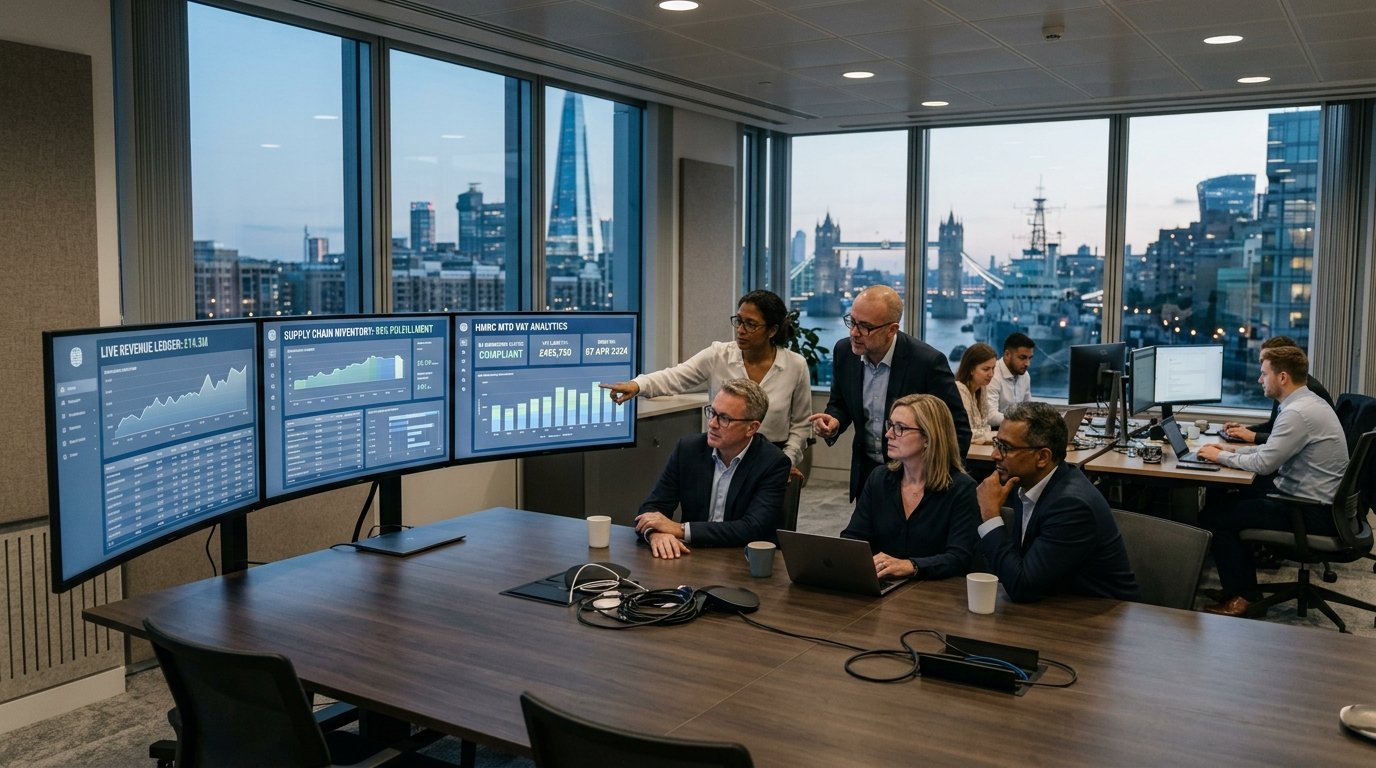
For the typical British small or medium enterprise (SME) employing 25 to 75 staff, the annual software balance sheet tells a harrowing financial story: between £35,000 and £85,000 spent every year on disconnected per-seat software-as-a-service (SaaS) subscriptions, supplemented by a precarious labyrinth of macro-heavy Excel spreadsheets. Operations teams find themselves trapped between platforms that do not speak to one another—paying separate monthly licences for HubSpot, Monday.com, Xero, TradeGecko, Zendesk, and DocuSign—while junior administrative staff lose 12 to 20 hours each week manually copying and re-keying customer records, purchase orders, and inventory tallies between browser tabs. This fragmented digital infrastructure creates severe operational drag. Every manual handoff introduces human error, inventory synchronization lag between warehouse depots and online storefronts leads to embarrassing backorders, and critical customer data sits scattered across unprotected desktop spreadsheets in direct violation of UK GDPR data governance mandates. Investing in custom business software uk is no longer an enterprise luxury reserved for FTSE 100 corporations. By commissioning lean, tailor-made bespoke erp development uk, forward-thinking British founders, COOs, and finance directors are eliminating redundant subscription seats, consolidating core business logic into a single relational database, and transforming fragmented operational overheads into durable, proprietary capital assets.
The Anatomy of SaaS Sprawl: The Compounding Cost of Fragmented Subscriptions#
How £30–£100+ Per-Seat Monthly Fees and Disconnected Workflows Drain UK Balance Sheets
SaaS bloat rarely happens deliberately; it accumulates incrementally over years of reactive problem-solving. A sales manager subscribes to a CRM at £65 per user per month. The operations lead adopts a project tracking tool at £24 per seat. The warehouse installs standalone inventory software at £180 per month plus user fees. Accounts runs Xero or Sage with half a dozen paid third-party marketplace add-ons for expense capture, purchase approval, and reporting.
Before long, a 35-person UK firm is maintaining 8 to 12 separate SaaS subscriptions costing upwards of £4,200 each month in direct licensing fees alone. Compounding this direct cash drain is the seat-licence penalty: every time the business hires a new estimator, project coordinator, or accounts assistant, the company is forced to purchase another bundle of recurring user licences—even if that employee only interacts with 5% of each tool’s feature set.
Furthermore, off-the-shelf software vendors enforce rigid, generic workflows designed for the lowest common denominator across global markets. British commercial firms frequently find that generic platforms lack essential localized requirements—such as strict HMRC Construction Industry Scheme (CIS) tax deductions, domestic reverse charge VAT logic, or seamless Companies House API identity lookups—which is why growing SMEs are turning to bespoke enterprise software development across the UK rather than relying on fragile spreadsheet workarounds.
- SaaS subscriptions penalise business growth: expanding headcount directly inflates monthly software licence costs.
- Disjointed platforms force employees to spend 25%+ of their working hours manually reconciling data across tabs.
- Generic global SaaS tools regularly fail to support UK-specific compliance, including domestic reverse charge VAT and CIS tax deductions.
Audit your company bank statements for the past 90 days. Group all software charges, multiply by 12, and divide by total headcount. If your annual software expenditure exceeds £1,200 per employee while your staff still use Excel to track jobs, you have acute SaaS bloat.
The Spreadsheet Trap: Single-Point-of-Failure Vulnerabilities & UK GDPR Exposure#
Why Macro-Heavy Excel Workbooks and Google Sheets Threaten Corporate Compliance and Trading Continuity
When off-the-shelf SaaS tools fail to accommodate proprietary pricing formulas or operational handoffs, British businesses default to Microsoft Excel or Google Sheets. What begins as a temporary helper sheet inevitably morphs into a monolithic "master operational workbook" that governs company quoting, job allocation, or material procurement.
Relying on spreadsheets for core operations introduces existential corporate risks:
1. Single-Point-of-Failure Knowledge Silos: Operational workbooks are almost always engineered by a single "spreadsheet wizard" within the organisation. When that employee departs or takes extended medical leave, the business is left with an opaque web of undocumented VLOOKUPs, nested IF statements, and fragile VBA macros that no remaining staff member understands or dares modify.
2. Zero Audit Trails & Concurrency Clashes: When multiple team members access shared workbooks across networked drives or OneDrive, formula overwrites, version drift, and sync conflicts are constant. An accidental keystroke can silently corrupt cell calculations, resulting in underpriced commercial tenders or unbilled subcontractor hours that bleed net profit margins without detection.
3. Severe UK GDPR Compliance Exposure: Spreadsheets containing customer names, personal telephone numbers, delivery addresses, and financial bank details lack granular, role-based access controls (RBAC). A single disgruntled employee or compromised laptop can export hundreds of unencrypted client records in seconds, triggering devastating mandatory reporting to the Information Commissioner’s Office (ICO) and catastrophic statutory penalties under the Data Protection Act 2018—liabilities that are eliminated by engaging an accredited custom software development company to build secure, role-authenticated internal platforms.
- Macro-heavy spreadsheets create single-person dependencies that paralyze operational agility when staff depart.
- Lack of transaction locking leads to corrupted cost models, underquoted jobs, and untraceable data alterations.
- Unencrypted spreadsheets containing personal data represent severe compliance liabilities under UK GDPR regulations.
36-Month TCO Matrix: Off-the-Shelf SaaS Stacks vs. Bespoke Internal Software#
Comparing 3-Year Expenditure, Workflow Fit, Data Sovereignty, and Integration Overhead for a 35-User UK Enterprise
Many UK managing directors assume that building custom operational software uk requires an unaffordable capital expenditure compared to low-friction SaaS signups. However, a rigorous 36-month Total Cost of Ownership (TCO) financial analysis proves that renting proprietary cloud software is dramatically more expensive over a medium-term horizon.
The following matrix models the commercial reality for a typical 35-user British commercial firm (e.g., regional trade distributor, specialist contractor, or professional service consultancy) over a three-year operational cycle:
| Evaluation Parameter | Off-the-Shelf Multi-SaaS Stack (Rented) | Bespoke Custom ERP System (Owned) |
|---|---|---|
| Year 1 Licensing / Build Cost | £46,200 (CRM, PM, ERP, Billing, Zapier connectors) | £38,500 (One-off architecture, build, and deployment) |
| Year 2 Licensing & Maintenance | £49,800 (Assuming modest 5% vendor price hikes & 3 new hires) | £4,800 (Managed cloud hosting & minor feature enhancements) |
| Year 3 Licensing & Maintenance | £54,200 (Compounding seat costs + API connector tiers) | £5,200 (Managed cloud hosting & database backups) |
| 3-Year Direct Software Spend | £150,200 (Pure operational expense with £0 balance-sheet equity) | £48,500 (Capitalized digital asset with full IP ownership) |
| Annual Clerical Data Entry Drag | £32,000/yr (750 hours/yr manual data re-keying between tools) | £3,200/yr (Unified relational database; zero duplicate entry) |
| Data Sovereignty & Residency | Vendor-hosted; data locked across US/EU multi-tenant clouds | 100% Client-Owned; dedicated UK PostgreSQL database (London AWS/Azure) |
| Custom Workflow Adaptability | Rigid templates; business must warp operations to fit vendor code | 100% Tailor-made; software maps exactly to your proprietary processes |
| Total 3-Year Commercial Impact | £246,200 Net Cash Drain (Licences + Clerical Inefficiency) | £58,100 Total Spend (£188,100 Net 3-Year Capital Savings) |
The Four Architectural Pillars of a Lean Custom ERP System#
Engineering Relational Data Integrity, MTD Invoicing, Dynamic Inventory, and Direct Client Communications
A modern custom business software uk solution does not attempt to replicate bloated, multi-million-pound legacy monoliths like SAP or Oracle. As engineered by our Birmingham manufacturing and enterprise software engineering team, it embodies a "lean operations core"—a lightning-fast, web-based internal hub engineered around the exact commercial mechanics that drive your revenue.
A production-grade bespoke ERP platform rests on four architectural pillars:
1. Centralised PostgreSQL Relational Core with Granular RBAC: All customer accounts, supplier ledgers, job files, and inventory records reside in a single, ACID-compliant relational database. Role-based access control (RBAC) ensures strict data governance: warehouse staff see pick-lists and dispatch queues; sales estimators see cost matrices and margin calculators; finance directors access consolidated P&L dashboards and bank reconciliations. Every database update is recorded in an immutable, tamper-proof audit log.
2. Automated Quote-to-Cash & HMRC Making Tax Digital (MTD) Invoicing: When a commercial quote is approved, the system automatically generates internal production work orders, reserves depot inventory, and schedules engineer site visits. Upon job sign-off via mobile touchscreen, the platform generates an HMRC-compliant digital VAT invoice (with domestic reverse charge calculations applied automatically where applicable) and pushes transactional journals to Xero or Sage via secure background webhooks.
3. Dynamic Multi-Depot Inventory & Purchase Order Approvals: Stock levels across primary warehouses, branch trade counters, and fleet service vans synchronize in real time. When stock crosses dynamic safety reorder thresholds, the system cross-references historical supplier lead times and minimum order quantities (MOQs), automatically preparing purchase orders for designated director authorization.
4. Direct WhatsApp Business API & SMS Client Communications: Rather than relying on easily overlooked email notifications, the platform integrates direct webhooks to the WhatsApp Business API and SMS gateways. Commercial clients receive automated, branded updates when quotes are ready, goods are dispatched, or engineers are 30 minutes away, reducing inbound customer chase calls by over 60%.
- A single PostgreSQL database replaces 6+ disconnected SaaS silos with zero data duplication.
- Automated quote-to-cash workflows compress billing cycles from 14 days to under 15 minutes.
- Built-in HMRC MTD compliance guarantees accurate VAT and CIS calculations without manual bookkeeping.
- Automated WhatsApp and SMS dispatches drastically reduce inbound customer status enquiries.
Design your custom ERP as a Progressive Web App (PWA) with custom UK web application development and portal engineering. This enables warehouse staff and mobile field engineers to access the system on iPads or Android tablets without requiring costly native app store development or third-party mobile licence fees.
The Financial Math: Build vs. Rent 36-Month ROI Analysis#
How a One-Off Capital Investment in Custom Software Breaks Even Within 12 to 18 Months
From a financial director’s perspective, transitioning from rented SaaS subscriptions to custom operational software uk represents an astute reallocation of corporate capital. Subscription fees are treated as recurring operational expenditure (OpEx) that permanently inflates overheads without accumulating enterprise value. In contrast, commissioning proprietary software creates an identifiable intangible asset on the corporate balance sheet that qualifies for UK Corporation Tax capital allowances and R&D tax incentives where technical uncertainties are resolved.
Consider the financial trajectory of a typical UK enterprise paying £3,850 per month across multiple SaaS licences. Over 36 months, the business will surrender £138,600 in licensing fees alone—receiving zero equity return upon contract termination.
A bespoke internal software solution delivering the exact same functionality typically requires an upfront engineering investment of £32,000 to £45,000, followed by modest hosting and maintenance costs of approximately £350 to £500 per month. By month 14, the cumulative expenditure curves intersect: the custom system breaks even, and every subsequent month generates £3,350+ in pure recurring balance-sheet savings.
- Bespoke software shifts expenditure from wasteful OpEx rent into capitalized balance-sheet digital equity.
- Typical breakeven occurs between 12 and 18 months, generating thousands in ongoing monthly cash savings.
- Custom systems eliminate per-seat licensing penalties, allowing headcount expansion at zero incremental software cost.
Greater Manchester Specialist Building Materials Distributor
A regional wholesale distributor and trade supplier in the Greater Manchester area operating 3 branch trade counters was paying £4,200 monthly across Salesforce, TradeGecko, and fragmented Excel pricing matrices. Price updates took 48 hours to propagate, resulting in frequent £500+ quoting discrepancies on high-volume timber and steel orders. VYDexa Technologies engineered a bespoke, cloud-native ERP and quoting portal on PostgreSQL and React. Commercial estimators now generate complex multi-branch trade quotes in 90 seconds, trade counter staff process collections on touchscreens with zero lag, and the firm eliminated £44,800 in recurring annual SaaS subscriptions within its first year of operation.
A Pragmatic Migration Roadmap: Phasing Out Disjointed Tools Without Operational Downtime#
A Four-Stage Engineering Playbook from Data Sanitisation to Supervised Cutover
The prospect of replacing core business systems can trigger anxiety among operations leaders who fear business disruption, lost customer orders, and staff friction. However, enterprise-grade software engineering does not rely on risky "big bang" weekend overhauls. Instead, it employs a phased, modular migration strategy that guarantees zero disruption to day-to-day trading.
Here is the battle-tested migration roadmap VYDexa Technologies deploys for UK commercial enterprises:
Stage 1: Process Mapping & Data Sanitisation (Weeks 1–3). Audit your existing database exports and operational Excel sheets. Scrub obsolete customer records, deduplicate vendor ledgers, and standardize product SKUs. Map your core business logic into clean entity-relationship diagrams (ERDs).
Stage 2: Core Architecture & High-Friction MVP Build (Weeks 4–7). Build the central relational database and deploy the single highest-friction operational module—typically the quote generator, order intake desk, or warehouse dispatch queue. Run this module in staging with historical production data to validate speed and usability.
Stage 3: Parallel Running & Bi-Directional Sync (Weeks 8–10). Connect the new custom system to your existing accounting package (Xero or Sage) via background webhooks. Run the custom module alongside legacy spreadsheets for two complete billing cycles. Staff cross-verify outputs, ensuring 100% mathematical parity in VAT and financial calculations.
Stage 4: Modular Sunsetting & Production Cutover (Weeks 11+). Decommission legacy spreadsheet workbooks and cancel redundant SaaS subscriptions one by one as each corresponding custom module goes live. Staff onboarding is rapid because the software was custom-built around their exact daily workflows rather than generic vendor templates.
- Phased rollouts replace spreadsheets module by module, eliminating operational downtime.
- Parallel running guarantees 100% accounting and VAT parity before cutting over from legacy tools.
- Atomic database transactions eliminate race conditions, duplicate invoices, and inventory overselling.
import { prisma } from './db';
import { postHMRCVatInvoice } from './integrations/xero';
import { sendWhatsAppCustomerNotification } from './integrations/whatsapp';

interface FinalizeQuoteParams {
  quoteId: string;
  userId: string;
  userRole: 'ADMIN' | 'OPERATIONS' | 'FINANCE';
}

export async function convertQuoteToProductionOrder({ quoteId, userId, userRole }: FinalizeQuoteParams) {
  // 1. Enforce Role-Based Access Control (RBAC)
  if (!['ADMIN', 'OPERATIONS'].includes(userRole)) {
    throw new Error('Forbidden: User lacks clearance to authorize production work orders');
  }

  // 2. Atomic database transaction to prevent inventory overselling and duplicate invoicing
  return await prisma.$transaction(async (tx) => {
    const quote = await tx.commercialQuote.findUniqueOrThrow({
      where: { id: quoteId },
      include: { lineItems: true, customer: true }
    });

    if (quote.status !== 'CLIENT_APPROVED') {
      throw new Error(`Invalid state transition: Quote ${quoteId} is currently ${quote.status}`);
    }

    // Deduct allocated inventory across warehouse depots
    for (const item of quote.lineItems) {
      await tx.depotStock.update({
        where: { sku_depotId: { sku: item.sku, depotId: item.allocatedDepotId } },
        data: { quantityAvailable: { decrement: item.quantity } }
      });
    }

    // Generate production order and invoice
    const order = await tx.productionOrder.create({
      data: {
        quoteId: quote.id,
        customerId: quote.customerId,
        netTotalGBP: quote.netTotalGBP,
        vatTotalGBP: quote.vatTotalGBP,
        status: 'IN_PRODUCTION',
        authorizedByUserId: userId
      }
    });

    // 3. Post HMRC-compliant digital journal to Xero / MTD accounting ledger
    const xeroInvoice = await postHMRCVatInvoice({
      customerVatNumber: quote.customer.vatNumber,
      orderNumber: order.id,
      netGBP: quote.netTotalGBP,
      vatGBP: quote.vatTotalGBP
    });

    // 4. Dispatch automated customer confirmation via WhatsApp API
    await sendWhatsAppCustomerNotification({
      recipientPhone: quote.customer.contactPhone,
      messageTemplate: 'order_confirmed_production',
      parameters: [quote.customer.contactName, order.id]
    });

    return { success: true, orderId: order.id, xeroInvoiceId: xeroInvoice.id };
  });
}
Conclusion & Strategic Next Steps
Tolerating fragmented spreadsheets and compounding SaaS subscription fees is an expensive operational compromise that no ambitious UK business needs to endure. By commissioning custom business software uk, business leaders regain control over their data, eliminate thousands of hours in administrative waste, and equip their teams with purpose-built internal tools that scale effortlessly as commercial revenues expand. At VYDexa Technologies (trusted UK digital engineering and enterprise growth partner), we operate as a dedicated technology partner for British enterprises. Our Manchester digital transformation and custom ERP engineering consultants collaborate with leadership teams nationwide to build bespoke ERP platforms, integrated quote-to-cash workflows, and robust business management systems with 100% client code ownership, zero monthly per-seat licensing penalties, and seamless remote collaboration during UK working hours (GMT/BST). Are you ready to stop renting generic SaaS tools and start building balance-sheet software equity? Contact our engineering team today to schedule your Free Digital Systems & SaaS Waste Audit. We will analyze your existing software expenditures, identify your operational bottlenecks, and provide a clear, commercially grounded roadmap to transition your business onto a high-performance custom ERP.
Frequently Asked Questions
Direct answers to common commercial, engineering, and SEO queries on this topic.
Off-the-shelf SaaS tools impose compounding per-seat monthly subscription fees that severely penalise business expansion while forcing staff to adapt to rigid, generic workflows. Furthermore, global SaaS platforms regularly fail to accommodate localized UK compliance requirements such as HMRC Making Tax Digital (MTD), domestic reverse charge VAT, and Construction Industry Scheme (CIS) deductions. Custom business software is engineered around your exact commercial processes, provides 100% proprietary code ownership with zero monthly per-user licensing fees, and typically pays for itself within 12 to 18 months.
VYDexa Core Practice Capabilities
Bespoke ERP systems, internal operations portals, and automated quote-to-cash pipelines.
High-performance customer portals, progressive web apps, and enterprise client dashboards.
Technical SEO, Generative Engine Optimisation (GEO), and commercial search dominance for UK firms.

